The Camps Experience
-Temporary Detention Centers-
1.Were Japanese Americans given adequate care and accommodations as they were rounded up? Were they given assurances and clear information on what the future held for them?
-- No they were not given adequate care because they were imprisoned with barbed wire fenced and armed guard towers with guns facing toward the inmates surrounded these compounds.
-Permanent WRA Camps-
-Permanent WRA Camps-
2.Discuss the claim by the U.S. Government that the camps were for the protection of Japanese Americans. Were the barbed wire fences and guard towers meant to keep vigilantes out or Japanese American inmates in?
-- The purpose of the barb wire fences were simply to keep the inmates inside of the camp. The Government wanted to keep the Japanese Americas in. They thought the barb wire fences would keep them safe.
-- The purpose of the barb wire fences were simply to keep the inmates inside of the camp. The Government wanted to keep the Japanese Americas in. They thought the barb wire fences would keep them safe.
-Camp Life-
3.Were the camps "resettlement communities," or prisons? What's the difference between the two?
-- Inmates had led to believe that these more permanent centers would be"resettlement communities" not prisons ,however, they found themselves in over crowded single rooms with no furniture except for cots and a pot-bellied stove. The Camp was considered a prison , because no one had freedom. A community is a group of people living in the same place sharing common values , where as, a prison is a building in which people are placed for committing a crime or disobeying the laws.
-- Inmates had led to believe that these more permanent centers would be"resettlement communities" not prisons ,however, they found themselves in over crowded single rooms with no furniture except for cots and a pot-bellied stove. The Camp was considered a prison , because no one had freedom. A community is a group of people living in the same place sharing common values , where as, a prison is a building in which people are placed for committing a crime or disobeying the laws.
4.Did the war Relocation Authority take measures to protect family life and privacy?
-- No , people homes were invaded and they were given no privacy. Privacy was nothing to them in internment camps.
-Questions of Loyalty-
5.How did Japanese Americans respond after being incarcerated without due process of law,to questions asking them whether or not they were unquestioningly loyal to this country?
-- They were willing to answer questions , they thought that it would help them get out sooner and freedom would be granted .
-- They were willing to answer questions , they thought that it would help them get out sooner and freedom would be granted .
-Tule Lake Segregation-
6.Were those who answered "no" to the loyalty questions clearly "disloyal" or were they voicing discontent with their treatment.
--Some in the camps answered "no" to both questions and were branded "disloyal." They were not disloyal in my eyes, they were just trying to do what was right and what they thought could be helpful to them.They were saying no because they didn't have any justice. They were free to say no , they could not claim loyalty to their country if they were born in Japan.
--Some in the camps answered "no" to both questions and were branded "disloyal." They were not disloyal in my eyes, they were just trying to do what was right and what they thought could be helpful to them.They were saying no because they didn't have any justice. They were free to say no , they could not claim loyalty to their country if they were born in Japan.
-Drafts Resister-
7.Why did these young men resist being drafted into the military? Write or improvise a conversation between two brothers in an internment camp who make two different opposing decisions on the drafts:one enlists, the other resists. What are their points of agreement, if any? How do they differ? Is one brother more patriotic than the other?
-- Some young men resisted being drafted on the grounds that their constitutional rights and those of their family members had been violated in the incarceration.
-- Some young men resisted being drafted on the grounds that their constitutional rights and those of their family members had been violated in the incarceration.
-Military Service-
8.What did it take to fight for a country that kept your family interned behind barbed wire?
-- It took being strong, for one , and also being disciplined, because knowing your fighting for a country which kept your family interned behind barbed wires was very hard , they did it just to show how loyal they were.
PartII
1. How do we prevent the injustice of internment from happening again?Perhaps it starts with learning about this historic mistake, as well as working to eliminate the causes for continuing racial prejudice today.
-- We can come together and not be so quick to judge people. We should simply accept people for who they are and not descriminate, because everyone deserves to be treated equally.
2. What do you think? What is your responsibility? What can you do as an individual? Your voice and actions can be an important part not only of preventing the gross injustice of internment from happening again, but also preventing the other negative effects of racial hatred and prejudice.
-- I think as an individual , I can do alot . First by start being a positive person in younger kids eyes. Teach them what is right and wrong , and never to judge someone by the way they look. We can all come together and teach the younger generation what the Japs went through.
Photo Essay

Mr. George Oni and his daughter Georgette Chize one biding farewell to brother Henry Oni. Tule Lake.
Photographer: Jack Iwata
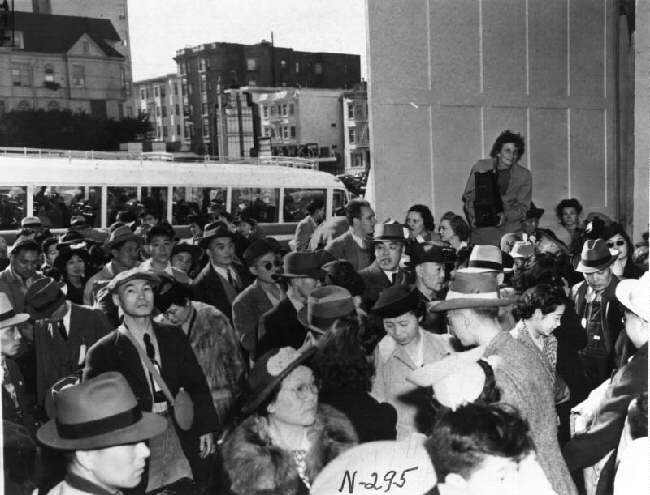
Removal of the Japanese Americans to Internment Camps.
Photographer: Dorothea Lange

Aerial Photo of Grenada Center from the Water Tower - Grenada
Relocation Center, Amache, Colorado.
Photographer: Joe McCelland

Japanese Americans Placed in Internment Camps
Photographer: Dorothea Lange

A Japanese family returns home to find their garage vandalized with graffiti and broken windows in Seattle, on May 10, 1945
Photographer: Joe McCelland

They Werent Being Disloyal,They Were Voicing Their Treatment Inside Of The Camps.
ReplyDeleteLove the repsonse on #1..
ReplyDeleteThis is a very nice website, and I love your background!
ReplyDeleteYour answer to #6 was good.
ReplyDeletein there situation what similarites did they have from ressetlement communitie to prison
Delete